How a bank in the Middle East fixes half its IT incidents before they are flagged
A team of Shapely agents now runs first-line IT operations around the clock, working in the bank's own IT tools through the screen.

Every branch and teller at this bank depends on its IT department. The team behind it is small, and its day was spent across a dozen tools: monitoring consoles, a ticketing system, admin consoles for core banking and the network, and spreadsheets for the rest.
Most of that time went on first-line work: reading alerts, sorting tickets and copying information from one tool into another. Problems usually reached IT only after a branch had already run into trouble. The core banking upgrade and the branch network renewal had both been postponed twice.
01Agents that use the screen
The bank had already tried a chatbot for IT tickets. It answered questions but fixed nothing. Many of its IT tools have no API, or one that covers only part of what engineers do in them, and scripted bots broke whenever a screen changed.
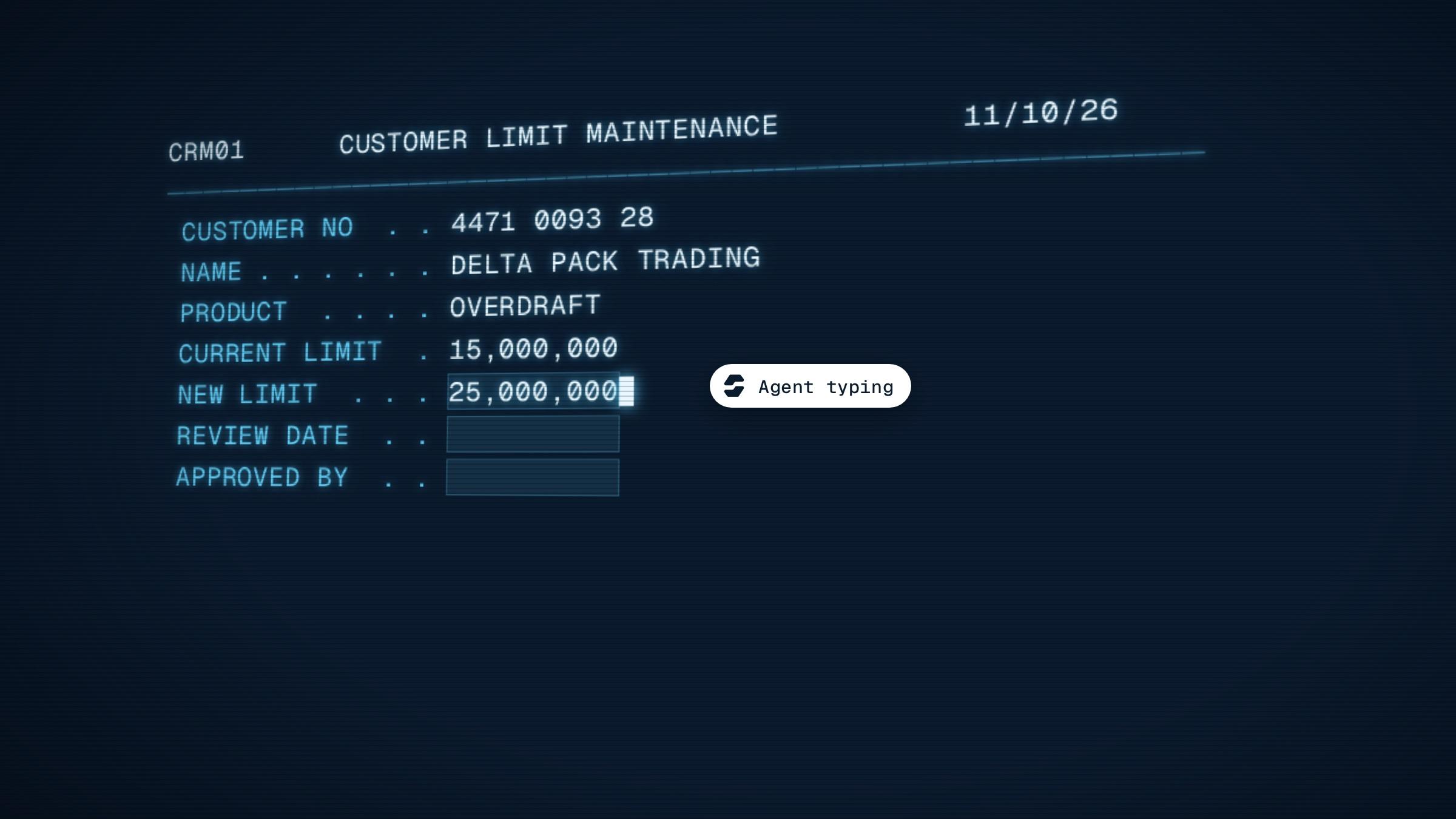
Shapely agents work in these tools the way an engineer does. Each agent has its own secure desktop. It reads the screen, finds what it needs, types, clicks, and checks the result before it moves on. If an interface changes or an action cannot be verified, the agent pauses and escalates to an engineer.
The first agents went live eight weeks after kick-off, once the bank's security team had signed off.
02Ahead of the problem
The agents watch every branch and every critical system day and night. When an agent spots an early sign of trouble, it investigates at once. If the fix is on the bank's pre-approved list (restarts, updates, known fixes), it applies it and checks that it worked. If not, it sends the on-call engineer a diagnosis and a proposed fix, ready to approve in Shapely OS.
By the time branches open in the morning, most overnight problems are already solved. The rest are tickets with the cause written down and the right team assigned.
03What the agents do every day
- Monitoring: Every alert is read and investigated. False alarms are closed with a note saying why.
- Incidents: Related alerts and tickets become one incident, with a diagnosis attached.
- Service desk: Staff ask in Arabic or English. Agents carry out the request in the right tool, with approvals.
- Changes: Each planned change is checked against past incidents and dependencies before it goes to the change board.
- Knowledge: When no procedure answers a question, agents ask the IT team and draft a new procedure for the IT and security teams to approve.
- Reporting: The head of IT starts each day with a brief: what happened in the last 24 hours, what was fixed and what needs a decision.
04From twelve branches to all of them
The bank started with monitoring and incident triage in twelve pilot branches. Within a month, a third of IT issues there were resolved before they affected branch operations.
After three months of testing and monitoring, the bank expanded the agents to every branch and the service desk. As the agents learned the bank's systems, that share rose to half.
05Built for a bank's security rules
The bank decides what agents may do alone and what needs a person.
- Privileged access: Agent accounts sit in the bank's privileged access management system. Each agent gets only the rights its tasks need, for as long as it needs them.
- Segregation of duties: An agent never approves its own work. Approvals follow the bank's existing segregation of duties.
- Human approval: Anything outside the pre-approved list waits for an engineer's approval in Shapely OS. If the bank's rules forbid an action, the agent refuses it.
- Audit trail: Every action is logged with the screen it was taken on and who approved it. Sessions can be replayed. Sensitive data is masked, and recordings are kept for the period the bank's policy sets.
- Data residency: The agents run where the bank's data residency and security rules require, and its data stays there.
06Results
- 50% of IT issues detected and resolved before they affect branch operations
- 75% of first-line IT tickets resolved without an engineer
- 70% faster resolution for incidents within the agents' scope
- 30% fewer recurring incidents, because agents trace problems to their root cause
An issue counts as resolved before it affects branch operations when it is fixed before any branch service slows or fails, and before anyone at the bank raises a ticket. Figures come from the bank's own monitoring and ticketing data, comparing the six months before the pilot with the six months after the rollout to every branch.
“Our branches used to tell us when something was wrong. Now we usually know first, and often it is already fixed.”
Chief Information Officer, a leading retail bank in the Middle East
If you want your IT team to focus on what matters, talk to us.